How can I help my elderly parents prepare for the future?
How can I help my elderly parents prepare for the future?
PLEASE NOTE: THIS ARTICLE IS OVER 1 MONTH OLD
The UK’s population is ageing, and with it comes questions many families put off for too long: what happens if you die without a Will, and who can make decisions for you if you lose mental capacity? This article covers both, plus what to do if a parent already has a dementia diagnosis.
An Ageing Population
According to the 2021 Census, that the population in England and Wales has continued to age. The number of people over the age of 65 has increased to over 11 million, up by 2.2% on the previous census in 2011 from 9.2 million people.
We are an ageing nation, this raises some practical issues that are worth thinking about in advance.
Will
The first is to have a Will, which everyone should have once they reach the legal age of 18, as this is when you can legally own assets.
A Will is a legal document that allows you to decide where to leave your assets on death.
What happens if you don’t have a Will?
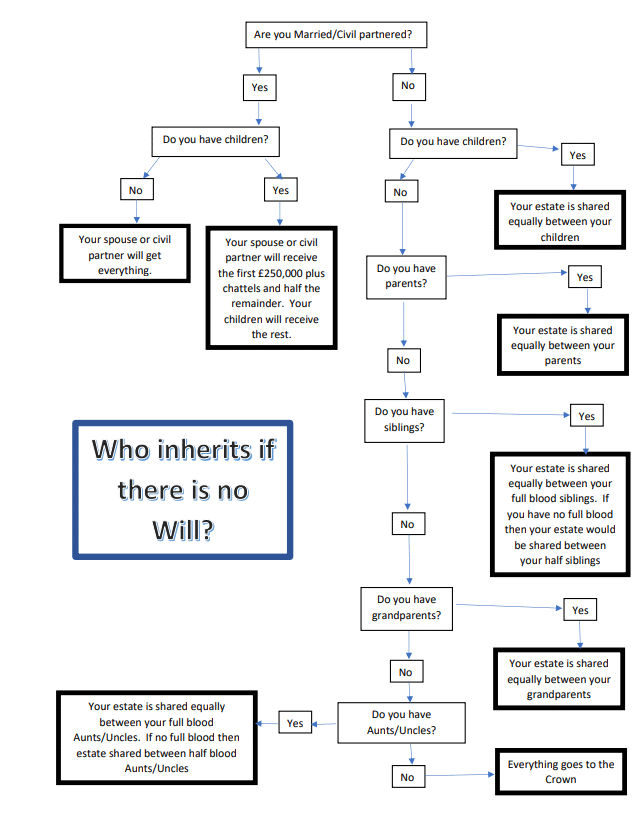
Without leaving a valid Will, you will be classed as dying “intestate”. This means that the intestacy rules of England and Wales will apply to your estate, which provides strict rules on the priority of who can inherit from you. The effect of this is that worst case scenario, your estate could pass to the Crown. Please see our intestacy chart below.
Another factor that has arisen since COVID, and a change in the Probate Registry Structure is that to obtain a Grant of Letters of Administration, and the legal document that allows you to administer and inherit from an intestate estate, the waiting time has increased from 3 weeks to anywhere up to 26 weeks or even longer for some estates.
It is therefore highly advisable that everyone has a Will, to make things easier and clearer for your family and/or friends.
Another issue from an ageing population is that we are seeing increased numbers of people suffering from Dementia related conditions. The dementia diagnosis rate in England was 64.5% in October 2023 according to NHS Digital Primary Care Dementia Data and Alzheimer’s Research UK.
It is more than likely that you have either experienced dementia directly in the family with an elderly parent or grandparent or have known someone who is caring for a family member with dementia.
Dementia does not automatically mean that a person has lost mental capacity, but it is a progressive declining condition and will likely cause the person to lose mental capacity in the future.
Although a family member may not be diagnosed initially with dementia, the following conditions may lead to dementia in the future, which some people are unaware of;
Parkinson’s disease.
Severe head injury.
Huntington’s disease.
Leukoencephalopathies.
Creutzfeldt-Jakob disease.
Some cases of multiple sclerosis (MS) or amyotrophic lateral sclerosis (ALS).
Multiple-system atrophy.
Infections such as late-stage syphilis
Given how common dementia is becoming in the over-65 population, it is important to prepare and one of the ways this can be done, is with a Lasting Power of Attorney.
A Lasting Power of Attorney is a legal document that lasts the whole of your lifetime. It covers mental incapacity so that your family or friends, whoever you trust and appoint as your attorneys can make decisions for you, should you be unable to make decision for yourself in the future.
See our article here on ‘Do I need a Lasting Power of Attorney?
What if my parents already have dementia?
If a person already has a diagnosis of dementia, they do not automatically lack mental capacity. Dementia is a disease where you can still have lucid moments to make decisions. In order to make a Lasting Power of Attorney, you would need to get a mental capacity report from your medical practitioner to advise whether they can make a Lasting Power of Attorney.
If the medical practitioner concludes that your parent does not have enough capacity to make a Lasting Power of Attorney, then the only option open to you, if they have not already made a Lasting Power of Attorney is to go to the Court of Protection to get a Court Order to be able to act and help your parent. See link here for more information on the Court of Protection.
If you need help or assistance on any of the issues raised, then please give us a call.
Because Your Family Matters
Articled dated: 23.07.2026
Bethany ChambersWills & Probate Paralegal
Bethany is our Wills & Probate Paralegal based at our Melton Mowbray Office.
She has an impressive law background after achieving an Honours Bachelor of Law and a Bachelor of Criminology and Criminal Justice. Beginning her career as a Litigation Paralegal in the Supreme Court of Queensland, Australia, Bethany has moved to th United Kingdom to become admitted as a Solicitor.
Outside of work, Bethany enjoys walking through the countryside with her dog as well as horse riding.
To provide the best experiences, we use technologies like cookies to store and/or access device information. Consenting to these technologies will allow us to process data such as browsing behaviour or unique IDs on this site. Not consenting or withdrawing consent, may adversely affect certain features and functions.
Functional
Always active
The technical storage or access is strictly necessary for the legitimate purpose of enabling the use of a specific service explicitly requested by the subscriber or user, or for the sole purpose of carrying out the transmission of a communication over an electronic communications network.
Preferences
The technical storage or access is necessary for the legitimate purpose of storing preferences that are not requested by the subscriber or user.
Statistics
The technical storage or access that is used exclusively for statistical purposes.The technical storage or access that is used exclusively for anonymous statistical purposes. Without a subpoena, voluntary compliance on the part of your Internet Service Provider, or additional records from a third party, information stored or retrieved for this purpose alone cannot usually be used to identify you.
Marketing
The technical storage or access is required to create user profiles to send advertising, or to track the user on a website or across several websites for similar marketing purposes.