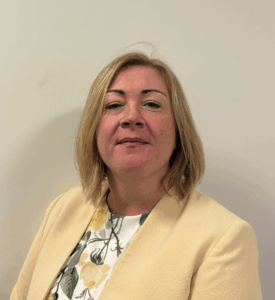
Tamara Dove-O’Hara, Family Solicitor, heads up our Andrew Isaacs Law Wakefield office at Langham House, Westgate. She advises families across Wakefield, Pontefract, Ossett, Normanton and the surrounding villages, including Horbury, Crofton, Ackworth and Featherstone.
Tamara helps with divorce and separation, financial settlements, arrangements for children, pre-nuptial and cohabitation agreements, and property disputes between unmarried partners.
Tamara Dove-O’Hara runs our Wakefield office and handles every case herself. Tamara qualified as a solicitor in 2009. She is a member of Resolution, the national body of family lawyers who resolve disputes in a constructive, non-confrontational way.
She advises on divorce and separation, financial settlements, child arrangements and parental responsibility, pre-nuptial and cohabitation agreements, and property disputes between unmarried couples.
If you live with a partner but aren’t married, separating can leave real uncertainty about the home. There is no “common law marriage” in English law. Unlike a divorcing couple, you can’t ask the court to divide property based on what’s fair or what each of you needs. Instead, who is entitled to the home usually depends on whose name is on the deeds, what you agreed and what each of you paid towards it.
Tamara acts for unmarried couples in property disputes under the Trusts of Land and Appointment of Trustees Act 1996 (TOLATA). For example, she can help if a former partner won’t agree to sell, or if you contributed to a home that is in your partner’s sole name.
She also prepares cohabitation agreements for couples who want certainty about their home and finances from the start.
Read more about how we help unmarried couples →
Call our Wakefield office on 01924 666238.

We act for clients in Wakefield, Pontefract, Ossett, Normanton, Horbury, Crofton, Ackworth, Featherstone and the surrounding villages. Langham House is under five minutes’ walk from Wakefield Westgate station and around five minutes’ drive from junctions 39, 40 and 41 of the M1.
There is no client parking at Langham House, but there are pay and display car parks nearby, including Westgate car park and the Merchant Gate multi-storey.
We offer a fixed fee divorce where the divorce is not disputed. You can see our current fixed fee, and what it includes, on our divorce page. If any work falls outside the fixed fee, we will discuss the cost with you before it starts.
We do not offer free initial advice. Instead, we offer an initial fixed fee consultation, where you can talk through your situation, the process and the likely costs before making any commitment.
You do not have to use a solicitor to apply for a divorce, and some couples start the application themselves online. A solicitor is most useful where there is a home, pensions, savings or children to sort out, or where your former partner does not agree. We can handle an undisputed divorce for a fixed fee and advise you on a financial order, so any settlement is legally binding.
No. Andrew Isaacs Law does not offer legal aid at any of its offices, including Wakefield. Our work is privately funded, and we will confirm costs with you before any work starts.
Under the no-fault divorce process introduced in 2022, an uncontested divorce takes a minimum of 26 weeks (6 months) from application to final order. This includes a 20-week reflection period followed by a 6-week period before the final order. In general it takes on average 8 months. Cases involving disputed finances or children matters may take longer to resolve fully even after the divorce itself is finalised.
No. Appointments can take place face to face at our Wakefield office, by telephone or by video, whichever is your preference. Documents can also be signed electronically.
A financial order (also called a consent order or financial remedy order) is a court order setting out how marital assets, pensions, property, savings and debts are divided on divorce. Without one, your former spouse can bring a financial claim against you years later, even after the divorce is finalised. We strongly recommend every divorcing couple secures a financial order, ideally by consent.
After separation, parents need to agree where children live, how often they see each parent, schooling, holidays and other practical matters. Most parents agree these arrangements directly or with the help of a mediator. Where agreement is not possible, we apply to the family court for a Child Arrangements Order. Mediation (a MIAM) is normally required before any court application unless an exemption applies.
Unmarried couples have far fewer automatic rights than married couples on separation. There is no “common law marriage” in English law. Property, savings and pensions are generally divided based on legal ownership, not need. Tamara advises unmarried couples on cohabitation agreements (before or during living together) and on TOLATA claims (Trusts of Land and Appointment of Trustees Act 1996) where a shared home is disputed on separation.
The Court of Protection makes decisions for adults who lack mental capacity to make decisions themselves (often due to dementia, brain injury or learning disability). We apply for Deputyship orders (so a Deputy can manage finances or welfare), statutory wills, and other applications under the Mental Capacity Act 2005 for Wakefield families.
Yes. Same-sex divorces (where the couple married) and civil partnership dissolutions follow the same legal process as opposite-sex divorces in England and Wales. Andrew Isaacs Law has experience in both. The financial and children law principles are identical regardless of the couple’s gender or sexual orientation.
Many family matters are now resolved without any court attendance, particularly uncontested no-fault divorces. Where a hearing is needed, it may take place in person or remotely by video link, depending on the type of hearing. We prepare you thoroughly for any hearing you do need to join.
Call us now, our phone lines are open 24 hours a day, 7 days a week 01302 349 480 or fill out our enquiry form here